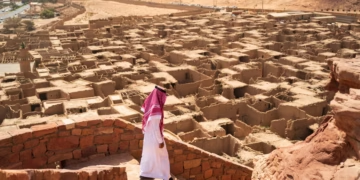
Islamic sources speak of nations that rose, denied their prophets, built power, carved homes into mountains, ruled over lands, then disappeared.
Some are named clearly in the Qur’an: Aad, Thamud, Madyan, the People of Rass, the People of Nuh, the People of Lut, Pharaoh’s people, and the People of Tubba.
Others are left unnamed.
The Qur’an says:
“Has there not reached you the news of those before you – the people of Noah and Aad and Thamud and those after them? No one knows them but Allah.”
Surah Ibrahim 14:9
This verse is important. It tells us that human history contains vanished nations known fully only to Allah. Islamic history is not limited to what archaeology has uncovered or what modern textbooks preserve. There were peoples, messengers and civilisations whose stories were not passed down in detail.
Nations Named, Nations Hidden
The Qur’an repeatedly uses destroyed nations as warnings.
In Surah Qaf, Allah mentions the People of Nuh, the People of Rass, Thamud, Aad, Pharaoh, the brothers of Lut, the People of the Thicket and the People of Tubba. All of them rejected messengers, and all became examples for later generations.
In Surah Ghafir, Allah tells the Prophet ﷺ that some messengers were mentioned to him and others were not. This means revelation intentionally gives only part of the record. There were prophets and communities whose details were not preserved for us.
That alone makes the subject powerful.
Islamic sources do not present history as a neat list of known empires. They present history as a graveyard of nations, many of whom are forgotten by people but not by Allah.
Aad: The People of Power
The people of Aad are among the most famous lost nations in the Qur’an.
They were known for strength, construction and arrogance. The Qur’an connects them with Iram of the pillars, describing a civilisation unlike any other in the lands. Their destruction became a warning that power without obedience does not save a nation.
Their story appears in several surahs, including al-Fajr, Hud and ash-Shu’ara. The repeated Qur’anic lesson is direct: they were not destroyed because they were weak, but because they rejected the truth despite their strength.
Aad represents a civilisation that trusted its power until its power became useless.
Thamud: The Mountain Builders
Thamud are another major lost nation.
They are connected to Prophet Salih, peace be upon him, and are described in the Qur’an as people who carved homes into the mountains while feeling secure. Surah al-Hijr mentions the dwellers of al-Hijr and says they carved houses from the mountains, but what they earned did not protect them.
Their ruins carried such seriousness that the Prophet ﷺ warned his Companions about entering them casually.
In Sahih al-Bukhari, when the Prophet ﷺ passed by the dwellings of the people of al-Hijr, he said not to enter the ruined dwellings of those who wronged themselves unless entering while weeping, lest the same punishment should fall upon them.
This shows that ruins are not tourism first. In Islamic consciousness, ruins are reminders.
The People of Rass
The People of Rass are among the most mysterious groups mentioned in the Qur’an.
They are named in Surah al-Furqan and Surah Qaf, but the Qur’an gives very little detail about them. Surah al-Furqan lists them alongside Aad, Thamud and many generations in between.
Sunni tafsir preserves several explanations. Ibn Kathir mentions reports that the People of Rass were connected to a village of Thamud, while other reports say Rass was a well where they buried their prophet.
This is exactly what makes them intriguing. They are named, warned about and preserved in revelation, but their full history remains hidden.
The Qur’an does not satisfy every historical curiosity. It gives what is needed for guidance.
Madyan and the People of the Thicket
The people of Madyan were the nation of Prophet Shu’ayb, peace be upon him.
Their story is tied to trade, corruption in measurement, economic injustice and rejection of prophetic warning. The Qur’an refers to them alongside other destroyed peoples, and Surah Hud mentions their end after they rejected Shu’ayb.
The People of the Thicket are also mentioned in the Qur’an and are linked in tafsir discussions to the people addressed by Shu’ayb. Their story shows that corruption is not always only theological in the narrow sense. Fraud, exploitation and economic oppression can become causes of destruction when a nation refuses correction.
Hidden Nations and Forgotten Messengers
One of the most overlooked Qur’anic truths is that many messengers and peoples are unknown to us.
The Qur’an says some messengers were narrated to the Prophet ﷺ and others were not. It also says there were nations after Nuh, Aad and Thamud whom no one knows except Allah.
This prevents Muslims from treating known history as the full story of mankind.
Some tribes vanished.
Cities that collapsed.
Prophets whose names we do not know.
Warnings that were rejected.
Nations that left no readable inscription, no surviving empire and no public memory, but whose stories are known to Allah.
This is a serious theme in Islamic history: being remembered by people is not the measure of truth. Being accountable to Allah is.
Gog and Magog: The Hidden Nations Behind the Barrier
The most famous hidden nations in Islamic sources are Ya’juj and Ma’juj, known in English as Gog and Magog.
Their story appears in Surah al-Kahf during the account of Dhul-Qarnayn. He reached a people who complained that Gog and Magog were spreading corruption in the land, so he built a barrier of iron and molten copper between them and the people. The Qur’an says they could not climb over it or pierce it until the time appointed by Allah.
Ibn Kathir explains in his tafsir that Dhul-Qarnayn built the barrier between two mountains to block Gog and Magog from reaching the people they had been harming. He also connects their eventual release to the end-time events mentioned elsewhere in the Qur’an.
The key point is restraint. The Qur’an confirms their existence and the barrier. It does not give Muslims a confirmed modern map location. Any attempt to force a modern location without proof goes beyond the evidence.
Gog and Magog Near the End of Time
Authentic hadith adds more detail.
In Sahih Muslim, the Prophet ﷺ described events after the descent of Isa ibn Maryam, peace be upon him. Allah will reveal to Isa that He has brought out servants whom none will be able to fight. Isa will take the believers to Mount Tur, and Gog and Magog will spread through the land. The narration mentions that they will pass by water and consume it, showing the scale of their number and destruction.
Another narration in Sahih Muslim mentions that the barrier of Gog and Magog had been opened by a small amount, and the Prophet ﷺ demonstrated the size with his fingers.
These reports show that Gog and Magog are not just ancient tribes from a forgotten past. They remain connected to the final signs before the Hour.
Why These Stories Matter
The lost tribes and hidden nations of Islamic sources are not mentioned to create fantasy history.
They teach a pattern.
Nations rise.
They become powerful.
They receive warnings.
They reject truth.
They feel secure.
Then they fall.
Some leave ruins. Some leave names. Some leave nothing but a warning in revelation.
The same applies to hidden nations. Gog and Magog remind us that the world contains realities beyond what people can currently see, control or map. Their release is tied to Allah’s decree, not human speculation.
Conclusion
Islamic sources speak of lost tribes, destroyed civilisations and hidden nations with precision and restraint.
Aad and Thamud show that strength and architecture cannot save a people from divine punishment.
The People of Rass show that some nations are named but not fully explained.
Madyan shows that economic corruption can destroy a society.
The unnamed nations remind us that Allah knows histories mankind has forgotten.
And Gog and Magog remain the most mysterious hidden nations, sealed behind a barrier until the time Allah has decreed.
The lesson is not to chase maps and theories.
The lesson is to read history as the Qur’an teaches it: power fades, ruins speak, hidden nations remain hidden until Allah permits otherwise, and no civilisation is safe when it rejects the truth.