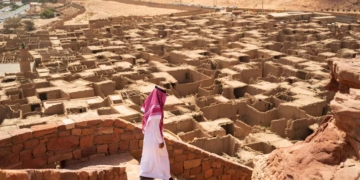
Abandoned houses, empty ruins, dark valleys and deserted places have always carried a strange reputation.
People avoid them at night. Travellers speak about them with caution. Old communities often attach stories of jinn, fear and unseen presence to them.
But what does Islam actually say?
The belief in jinn is not folklore. It is part of the Qur’anic worldview. Allah says that the jinn were created from a smokeless flame of fire, and the Qur’an speaks of them as real beings with belief, disbelief, responsibility and accountability.
The question is more specific: do jinn gather in abandoned places?
Where Do Jinn Live?
Sunni scholars mention that jinn live on the earth, but they are often associated with places that humans normally avoid: ruins, empty areas, deserts, toilets, garbage dumps and places of impurity.
IslamQA states that jinn are mostly found in ruins and unclean places such as bathrooms, dunghills, garbage dumps and graveyards, and connects this to the Prophet’s teaching of protective adhkar when entering such places.
IslamWeb similarly mentions that jinn often inhabit ruins and places of impurity, and that some scholars linked the bathroom supplication to the fact that such places may be dwellings of jinn.
This does not mean every abandoned building is “haunted”. It means such places are treated with caution in Islamic tradition because they are empty, neglected, impure, isolated or outside normal human habitation.
Toilets, Waste Areas and Devils
One of the clearest texts on this subject concerns toilets and waste areas.
A hadith in Sunan Ibn Majah states that these waste areas are visited by devils, so when a person enters, he should say:
“O Allah, I seek refuge with You from male and female devils.”
The same meaning is reported in other hadith collections.
This hadith is important because it shows the Islamic method.
Islam does not tell Muslims to panic.
It tells them to seek refuge in Allah.
The danger is not handled through charms, rituals, ghost-hunting, calling upon spirits, or speaking to the unseen. The protection is simple: remembrance of Allah, du’a and discipline.
Seeking Refuge in Allah, Not in Jinn
Before Islam, some Arabs believed that when entering a valley or unknown place, they should seek protection from the chief of the jinn of that area.
The Qur’an condemned this practice:
“And some men used to seek refuge with some jinn, so they increased each other in wickedness.”
Surah al-Jinn 72:6
This verse matters because it corrects a major mistake.
The answer to fear of jinn is not to negotiate with jinn.
It is not to ask them for protection.
It is not to respect them through offerings, candles, blood, incense, spells or local customs.
The answer is to seek refuge in Allah alone.
The Prophetic Protection When Stopping Somewhere
There is also a powerful hadith for travellers, campers or anyone stopping in an unfamiliar place.
In Sahih Muslim, the Prophet ﷺ said that whoever stops at a place and says:
“I seek refuge in the Perfect Words of Allah from the evil of what He has created,”
nothing will harm him until he leaves that place.
This is one of the strongest protections mentioned in the Sunnah for unknown locations.
It applies naturally to valleys, roads, abandoned places, remote areas and places where a person feels exposed. Again, the method is not superstition. It is tawakkul, remembrance and seeking refuge in Allah.
Bones, Dung and the Unseen World
Another hadith shows that the jinn have their own unseen life and provisions.
In Sahih Muslim, the Prophet ﷺ forbade using bones and dung for cleaning after relieving oneself, explaining that they are food for the jinn.
This hadith is relevant because it shows that the jinn are not simply “ghosts” in the popular sense. They are a real creation with their own world, needs and existence, though much of that world remains hidden from us.
Islam gives us enough knowledge to believe, protect ourselves and avoid harm.
It does not open the door to obsession.
Abandoned Places and Exaggeration
Many people take the subject too far.
They assume every noise is jinn.
Every abandoned house becomes possessed.
Every illness becomes magic.
Every nightmare becomes an attack.
Every old building becomes a story.
This is not the balanced Islamic approach.
Yes, jinn exist.
Yes, some places are more associated with them than others.
Yes, Muslims should be cautious in ruins, toilets, empty places and remote areas.
But fear should not control the believer. A Muslim does not build life around suspicion, superstition and panic. A Muslim builds life around Allah, prayer, Qur’an, adhkar and sound judgement.
What To Do Before Entering Abandoned or Isolated Places
The Islamic guidance is practical.
Say Bismillah.
Avoid entering dangerous places without need.
Do not mock, provoke or call out to jinn.
Do not seek help from them.
Do not perform strange rituals.
Say the du’a from Sahih Muslim when stopping somewhere:
“A’udhu bi kalimatillahit-tammati min sharri ma khalaq.”
“I seek refuge in the Perfect Words of Allah from the evil of what He has created.”
If entering a toilet or waste area, say the established du’a seeking refuge from male and female devils.
If fear becomes excessive, return to the basics: prayer, Qur’an, morning and evening adhkar, and a sound mind.
The Real Lesson
The jinn of abandoned places are not a topic for entertainment.
They remind us that the world is larger than what we see. Human beings are not the only creation living on earth. There are realities beyond the visible, and Islam teaches how to deal with them without falling into superstition.
The believer does not deny the unseen.
The believer also does not chase it recklessly.
Between denial and obsession is the path of Islam: believe what revelation confirms, avoid what brings harm, and seek protection only from Allah.
Conclusion
Islam confirms the reality of jinn and teaches that they live on the earth. Sunni scholars have long mentioned that they are often found in ruins, deserted places and impure areas such as toilets and garbage sites.
But Islam does not turn this into horror mythology.
It gives clear protection: seek refuge in Allah, say the prophetic adhkar, avoid filthy and dangerous places without need, and never seek help from jinn.
Abandoned places may carry stories.
But the Muslim carries something stronger: the remembrance of Allah.