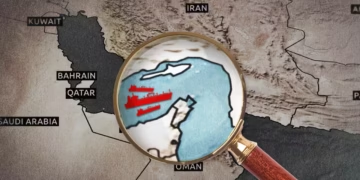
The United States is significantly reinforcing its military presence in the Middle East, with the deployment of the aircraft carrier USS Theodore Roosevelt and its strike group, alongside an amphibious group carrying US Marines.
US officials told The Wall Street Journal that the ships, fighter jets, sailors and Marines are expected to reach the region by the end of November, potentially adding between 9,000 and 10,000 US military personnel to forces already deployed there.
The aircraft carriers USS George H.W. Bush and USS George Washington are already operating in the region, meaning the arrival of the Theodore Roosevelt could bring the number of US carrier strike groups in the Middle East to three.
Reports indicate, however, that the Theodore Roosevelt could eventually replace the George Washington, which was transferred from the Pacific to the Middle East in August to replace the USS Abraham Lincoln.
Military Build-Up Comes Amid New Threats Against Iran
The military reinforcement comes as US President Donald Trump has again threatened further strikes against Iran.
Trump also claimed that preliminary indications suggested a possible connection between Iran and the co-pilot involved in Wednesday’s Flydubai incident involving a flight bound for the Israeli occupation.
Asked by a reporter whether there were any connections between the co-pilot and Tehran, Trump said: “The answer, based on what I’m hearing, is yes, but we’re working on that right now.”
He provided no evidence for the claim, while investigations into the co-pilot’s motives and possible external connections remain ongoing.
Trump warned that the United States would respond if an Iranian connection were established.
“They’re going to get hit very hard, don’t worry,” Trump said. “You just have to ask them. They know what happened. They’re going to get hit very hard.”
His remarks came despite no direct Iranian link having been publicly established in the ongoing investigation.
Trump Raises Prospect of Renewed Strikes
The deployments also come days after Trump rejected an Iranian proposal aimed at reopening the Strait of Hormuz and resuming negotiations over Iran’s nuclear programme.
Trump told Time that he could resume strikes against Iran after the US midterm elections if an agreement was not reached.
The Wall Street Journal reported that maintaining a third aircraft carrier in the region would provide Trump with greater military capacity and additional options should he decide to launch another attack.
The Iranian proposal rejected by Trump would have allowed the Strait of Hormuz to reopen, restoring passage through a waterway that normally carries about one-fifth of the world’s oil, while nuclear talks between Tehran and Washington would resume in exchange for the lifting of the US blockade on Iranian ports.
The proposal included broader conditions relating to US sanctions and the naval blockade, but Trump rejected Tehran’s terms.
Air Defence and Airborne Forces Remain in Place
US War Secretary Pete Hegseth has also extended the deployments of other units considered important for major combat operations.
These include air-defence forces tasked with intercepting Iranian missiles and drones, as well as elements of the US Army’s 82nd Airborne Division.
The deployment of some 82nd Airborne personnel has been extended, while Patriot air-defence units are also expected to remain deployed for longer periods.
The 82nd Airborne Division is capable of carrying out a range of missions, including responding to military threats and parachuting into hostile territory to secure airports and other strategic positions on the ground.
The continuing presence of such units gives Washington capabilities extending beyond naval and aerial operations alone.
Around 20 US Warships in the Region
According to US Navy officials cited in the report, Washington has maintained approximately 20 warships in the region for months as part of its blockade operations and efforts to escort commercial vessels travelling through the Strait of Hormuz.
The latest deployments will add another carrier strike group and amphibious forces to an already extensive American military presence surrounding Iran.
The USS Makin Island Amphibious Ready Group has also departed California carrying Marines, while the Theodore Roosevelt left San Diego on its deployment towards the region.
The reinforcement gives Washington additional military assets at a time when diplomacy with Tehran remains stalled and Trump is openly leaving the possibility of renewed strikes on the table.