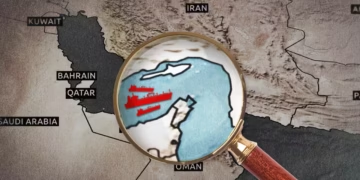
Confusion and contradictory reports dominated coverage of Wednesday’s Flydubai flight from the UAE to Israel, after an emergency forced the aircraft to divert to Saudi Arabia and triggered a flood of competing Israeli narratives about what had happened inside the cockpit.
The long day ended at around 6pm with the 174 Israeli passengers aboard the flight returning to Israel after spending hours at Tabuk Airport in Saudi Arabia.
During that time, Israeli media circulated reports claiming Riyadh had refused to allow Israeli aircraft to land at the airport to evacuate the passengers. The passengers themselves were also reported to have insisted that they would not return to Ben Gurion Airport aboard Emirati aircraft.
By the end of the day, the circumstances surrounding an alleged attempt by the co-pilot to bring down the aircraft remained unclear. Initial leaks spoke of a possible suicide attempt, raising unanswered questions over whether, if the account of an attempt to crash the aircraft is confirmed, the incident was intended as an attack against Israeli passengers or stemmed from personal motives, as earlier reports had suggested.
Israel Goes on Alert
Answers may take time to emerge. The co-pilot, who was reported to be of Omani origin, remained under investigation by Saudi authorities.
Meanwhile, the speed with which Prime Minister Benjamin Netanyahu’s circle described the incident as a “jihadist terrorist attack” suggested an effort to exploit the episode politically and electorally before the circumstances had been conclusively established.
Israel went on alert on Wednesday after air traffic control towers in Tel Aviv and Amman lost contact with the Flydubai aircraft, which had departed the UAE at 6:05am carrying 174 Israelis.
The flight to Tel Aviv normally takes around three hours. Approximately two and a half hours after departure, however, the aircraft reportedly experienced dangerous changes in speed before losing more than 14,000 feet of altitude in less than 30 seconds.
Two emergency signals were then transmitted.
The first was code 7700, the aviation emergency transponder code for a general emergency.
Minutes later, the aircraft transmitted code 7500, indicating unlawful interference aboard the plane and a possible hijacking or direct security threat.
The alerts prompted Israeli Air Force aircraft to begin searching for the plane.
Contact was subsequently restored through Saudi air traffic control, according to Israeli media reports. Early accounts then suggested the incident was not a hijacking, but a confrontation between the captain and co-pilot.
The narrative later shifted again, with the Israeli website Ynet reporting that the co-pilot, said to be of Omani origin, had attempted to crash the aircraft by sending it into a steep descent.
Ynet added that the co-pilot had joined Flydubai only nine months earlier and that authorities were investigating whether he held dual nationality.
Israel’s Channel 12 later reported that Saudi investigators questioning the injured co-pilot had found no indications at that stage that the incident constituted an act of terrorism.
Israeli Army Radio said the investigation was being conducted in Saudi Arabia and that the Israeli security establishment was not itself questioning the co-pilot.
It added that Israeli authorities would seek information from the Saudi investigation, particularly on whether the co-pilot had acted independently or had been sent by a hostile party.
At that stage, it said, there was no information establishing whether the incident had been directed by a foreign state or an organisation.
Channel 14 had earlier reported suspicions that one of the pilots had attempted suicide, claiming that the aircraft descended sharply from an altitude of 30,000 feet at close to Mach 1 until reaching 15,000 feet within a short period.
According to that account, the other pilot managed to stop him during a struggle.
Israeli broadcaster i24 cited passengers as saying: “One of the pilots stabbed the other, and the cockpit was full of blood. We thought we were not going to survive.”
Amid these conflicting accounts, an initial Israeli investigation reportedly assessed that the co-pilot had planned to crash the aircraft in order to kill the Israeli passengers aboard.
According to the preliminary findings cited in Israel, the co-pilot stabbed the captain while attempting to seize control of the aircraft and used the emergency axe kept in the cockpit for breaking aircraft windows when required.
Ynet later labelled the incident a terrorist attack and reported that investigators were examining whether the co-pilot might have been recruited by Iran.
At the same time, Israeli financial newspaper Calcalist quoted the chief executive of a company affiliated with Bank Leumi, who was among the passengers, describing how events unfolded.
“My wife was standing near the cockpit because my daughter was in the toilet, and suddenly she heard shouting from inside the cockpit,” he said.
“She shouted at a reserve pilot from Fiji and told him to go inside and check what was happening. As soon as he opened the door, I went in with two others and we neutralised the attacker.”
According to his account, the captain, who was Indian, had been stabbed by his Omani co-pilot.
A doctor aboard the flight reportedly treated the injured captain, allowing the aircraft to continue and eventually land safely at Tabuk Airport.
Netanyahu Government Moves Quickly to Frame the Incident
Following the incident, Netanyahu issued a video statement on Wednesday evening in which he said one of the Flydubai pilots had stabbed his colleague and attempted to crash the aircraft with everyone aboard.
He said the suspect had been detained and was being questioned by Saudi authorities.
Netanyahu described the incident as “an extremely serious security event” and said he had instructed Israeli security agencies to prepare for possible additional threats.
Israeli Defence Minister Israel Katz went further, describing what happened as a “jihadist attack”.
“According to the preliminary information available to us, the attacker’s intention was one thing: to crash the plane with all its passengers,” Katz claimed.
He then linked the incident to security warnings that he and Netanyahu had issued the previous Tuesday.
“When the prime minister and I issue security warnings and alerts based on intelligence information, it is better for everyone, whether our enemies abroad or former officials at home who are not informed, to listen and take them seriously,” Katz said.
Yet the Saudi investigation had, according to Channel 12, not established indications of terrorism at that stage, while Flydubai itself said the causes and motives remained unknown.
Lapid Accuses Netanyahu of Electoral Politics
Israeli opposition leader Yair Lapid challenged Netanyahu’s attempt to connect the incident with the security warnings issued a day earlier.
Lapid had received a security briefing from Netanyahu on Tuesday evening concerning those warnings.
In a statement, he said that “nothing even remotely resembling the aircraft incident appeared in the security briefing”.
He accused what he called Netanyahu’s “electoral propaganda mouthpieces” of generating a political storm around the incident.
“This noise being generated by the propaganda mouthpieces has managed to prove only one thing,” Lapid said, “that they, Netanyahu and his group, are trying to practise cheap politics at the expense of Israel’s security.”
He described Netanyahu’s circle as “reckless and irresponsible”.
An unnamed Israeli political official later responded that Netanyahu had warned of an increase in attacks against Israelis abroad.
Lapid, however, maintained that Netanyahu had said nothing whatsoever about a scenario involving an aircraft hijacking.
Flydubai Urges Against Speculation
Flydubai issued its own statement on Wednesday evening, describing the reason for the emergency landing simply as a “dispute in the cockpit”.
“The situation was successfully brought under control thanks to the Flydubai crew aboard the flight, who diverted the aircraft and landed safely at Tabuk Airport,” the airline said.
It added that all passengers and crew members were safe and that two replacement aircraft had been sent to Tabuk to transport them.
On the motive behind the cockpit confrontation, Flydubai stressed that the circumstances had not yet been established.
“At this early stage, the reasons and motives behind this incident remain unknown and are subject to an official investigation,” the company said.
It urged all parties to refrain from premature speculation while the authorities gathered the facts.
The statement stood in sharp contrast to the rapid escalation in Israeli political rhetoric, where an unresolved cockpit confrontation had already been framed by senior officials as a “jihadist attack” and linked to broader security warnings, even as the investigation in Saudi Arabia had yet to establish the motive.