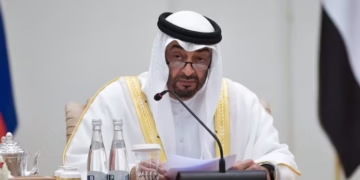
Allegations surrounding women fleeing Dubai’s ruling family have returned to the spotlight after Zeynab Jawadli, the former wife of Said bin Maktoum bin Rashid Al Maktoum, son of Dubai’s former ruler and nephew of its current ruler, published a disturbing video saying she had fled with her daughters out of fear of “abuse and intimidation” after they were taken from her in September 2025.
In her recorded testimony, Jawadli said she “was no longer safe”, alleged that police had repeatedly raided her home, and said she and her daughters had been living “as though they were hostages”.
She also said she had handed all available evidence to a British lawyer, who would make the case public should anything happen to her.
The latest allegations revive questions surrounding what has become a recurring pattern involving women connected to the Al Maktoum family: attempted escapes, disappearances, alleged abductions and efforts to contain the fallout.
The central questions remain difficult to ignore. Why have women repeatedly tried to flee one of the wealthiest ruling families in the region? And what would drive wives and princesses to risk their safety in attempts to leave Dubai secretly?
From Shamsa to Latifa, Haya and Now Zeynab
The history of women attempting to escape Dubai’s ruling family stretches back more than two decades.
One of the earliest and most prominent cases involved Sheikha Shamsa in 2000. Then 19 years old, she was living at the family’s estate in Surrey, south of London.
Shamsa reportedly took a car and fled. British media later reported that a private search team sent by the family located her in Cambridge, abducted her and forcibly returned her to Dubai aboard a private aircraft.
She has largely disappeared from public view ever since.
Years later, Sheikha Latifa bint Mohammed bin Rashid attempted to flee by sea in March 2018 aboard a yacht heading towards India.
Her escape ended following an intervention by special forces, after which Latifa was forcibly returned to Dubai.
Videos she recorded before attempting to escape, in which she spoke about abuse and harsh treatment, triggered international outrage after becoming public.
Then came the case of Princess Haya bint Al Hussein, the wife of Mohammed bin Rashid. She fled in 2019, initially travelling to Germany before settling in London.
The Guardian and other international media outlets reported at the time that Haya had hired a private security company to protect her home amid fears that she could be abducted as tensions with her husband escalated.
Princess Haya subsequently fought a high-profile legal battle in Britain.
The proceedings resulted in major findings by British courts, including findings that she had been subjected to “systematic intimidation” and that Mohammed bin Rashid was responsible for the abduction and detention of his daughters, Shamsa and Latifa.
Zeynab Jawadli and a New Generation of the Al Maktoum Family
Jawadli’s case brings strikingly similar allegations back into public view: a wife fleeing, claims of abduction and abuse, and an account of life inside the UAE that she portrays as intolerable before finding safety outside the country.
The principal difference is that the man at the centre of the latest allegations is not Dubai’s ruler himself, but a member of the next generation.
Said bin Maktoum bin Rashid is Mohammed bin Rashid’s nephew.
That distinction raises a broader question: are these cases the product of individual conduct, or do they point to a deeper culture extending across generations of the ruling household?
The UAE has invested heavily in cultivating an international image built around wealth, tourism, modern infrastructure and economic influence. Dubai in particular has become one of the region’s most prominent global destinations.
Yet the cases involving women within its ruling family reveal a sharply different picture.
For decades, this side of the ruling household remained largely shielded from sustained media scrutiny amid the UAE’s political influence and extensive investments in the West. But accounts of escape, coercion and alleged abuse gradually emerged, with some eventually becoming the subject of legal proceedings in Britain.
British reporting has drawn connections between the cases of Shamsa, Latifa and Haya, with a recurring theme of limited accountability within the ruling family and the alleged use of security power and coercive control rather than transparent judicial processes.
Human rights organisations have also argued that women in such circumstances lack meaningful mechanisms of protection, whether inside the UAE or, in some cases, even after travelling abroad.
The deeper issue exposed by the succession of cases is the repetition itself: similar allegations, the same ruling environment and a persistent imbalance between individual protection and concentrated political power.
For women who believe they have exhausted every other avenue, escape can consequently appear not simply as an act of defiance, but as the final option available to them.