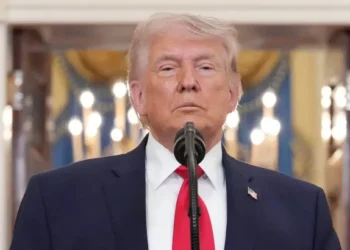
In the final moments, just 90 minutes before a deadline that had been framed as risking the destruction of an entire civilisation, US President Donald Trump stepped back from escalation, announcing a two week suspension of a full scale military offensive against Iran.
The sudden move, driven by last minute Pakistani mediation, temporarily defused a potential regional explosion. However, it immediately raised a critical question: does this mark the beginning of a genuine path towards a lasting settlement between Iran and the United States, or is it merely a calculated pause serving military and economic objectives on both sides?
De escalation at the Final Hour
Posting on Truth Social at 6:32 pm Eastern Time, Trump confirmed his decision shortly before the expiry of his ultimatum. He stated that, following discussions with Pakistan’s Prime Minister Shehbaz Sharif and military leadership, and conditional on Iran agreeing to the full, immediate, and secure reopening of the Strait of Hormuz, the United States would suspend its bombardment and offensive operations for two weeks.
Trump described the move as a mutual ceasefire, asserting that Washington had achieved and exceeded its military objectives. He added that his administration had received a 10 point proposal from Iran, which he described as a practical foundation for negotiations. According to his statement, most prior points of disagreement between the two sides had already been resolved, with the two week period allocated to finalising the agreement.
Tehran responded swiftly. Iran’s Foreign Minister Abbas Araghchi confirmed a preliminary understanding, stating that if attacks cease, Iranian forces would halt their defensive operations. He added that navigation through the Strait of Hormuz would remain open for two weeks under coordination with Iranian armed forces and within defined technical parameters.
Markets React Immediately
Despite the assertive tone of Trump’s announcement, analysts interpret the decision through an economic lens, pointing to internal pressures within the United States.
Global markets responded instantly. US crude futures fell sharply by 15 percent, dropping more than 20 dollars to settle at 92.36 dollars per barrel. In contrast, precious metals surged, with platinum rising over 3 percent and silver increasing by nearly 5 percent.
This immediate market response provides the White House with a strategic window to stabilise economic indicators ahead of a key transition in May, when Kevin Warsh is set to assume leadership of the Federal Reserve. The two week calm period may allow for interest rate reductions without the inflationary pressures that would likely follow a spike in energy prices if the Strait of Hormuz were to be closed.
Operational Pause for Military Forces
The suspension of hostilities, tied directly to the reopening of the Strait of Hormuz, appears less like a conclusion to the war and more like a tactical interval for military recalibration.
Observers suggest that the two week window offers an opportunity for intelligence gathering, repositioning of forces, and the replenishment or approval of new munitions. Both sides may use this period to prepare for a range of potential scenarios.
At the same time, Israel and the United States remain aware that Iran retains the capacity to launch missiles and drones. Any breach of the ceasefire by Washington or Tel Aviv could trigger a direct Iranian response, potentially returning the situation to full scale confrontation and leading to a renewed closure of the Strait, possibly for a longer duration.
Islamabad at the Centre of Negotiations
The ceasefire is widely viewed as a narrow window aimed at preventing immediate escalation rather than resolving a conflict rooted in decades of tension. However, the cost and consequences of recent weeks of confrontation may push all parties towards limited concessions in order to avoid a more severe outcome.
As preparations begin for negotiations in Islamabad, the region remains in a state of cautious calm. The coming days will determine whether this pause evolves into a framework for a final agreement that effectively ends the war, or whether it serves as a brief interruption before a more costly and expansive phase of conflict.